

Refresh of Is the consumer broken? (May 28, 2026), written after the September NFIB release.

In May I argued the consumer was sick of high prices, but not broken. The University of Michigan print was hot; the other three surveys were not. My take was simple: watch Conference Board Expectations, the New York Fed’s longer-horizon inflation expectations, and NFIB Uncertainty together. If all three start rolling over together, then the regime is shifting.
Five months later, we can run that test with fresh numbers. Spoiler: we are closer, but not there yet.
Reminder: UMich alone is still not enough
Michigan’s final September Index of Consumer Sentiment printed 48.1, up from the May final of 44.8, but still ugly — down from 51.7 in August and a four-month low at the time (University of Michigan Surveys of Consumers, final September 2026; release commentary Sept. 25–26, 2026). Long-run (5-year) inflation expectations there were 3.4%in September, down from 3.9% in May.
That is progress on the political-noise problem I suggested in May. It is not a clean bill of health. Treat Michigan as one input among many - never the whole case.
The three-indicator test, May vs now
1. Conference Board Expectations — rolling over
Then (May): Expectations rose 1.0 point to 74.4. Forward-looking consumers were getting less worried, not more.
Now (September): The Expectations Index fell 5.9 points to 63.6 — its third consecutive monthly decline. The headline Consumer Confidence Index fell 6.7 points to 81.9, from 88.6 in August. Present Situation dropped to 109.3. (The Conference Board / PR Newswire, Sept. 29, 2026.)
PNC Economics’ series read puts that 81.9 headline at the lowest since August 2013 (PNC Economics Research, Sept. 29, 2026). Conference Board’s own release does not state the historical comparison; I am citing PNC for that claim.
This leg of the panel has clearly rolled. Labor-market perceptions softened (jobs plentiful minus hard-to-get down to +1.7%), and write-ins leaned hard into prices and fuel.
2. New York Fed SCE — long end still anchored; short end hot
Then (May): One-year inflation expectations 3.6%; five-year stable at 3.0%.
Now (September): One-year rose 0.3 points to 3.9% — the highest since May 2023. Five-year unchanged at 3.0%. Three-year ticked up to 3.3%. (Federal Reserve Bank of New York, released Oct. 7, 2026; fielded Sept. 1–30, 2026.)
So the FOMC’s preferred long-horizon anchor has not rolled over. Near-term inflation anxiety has. Spending growth expectations also jumped to 5.5% (highest since May 2023) while households’ self-assessed financial situation deteriorated — a stressed consumer who still expects to spend more nominally, which is consistent with price pressure, not with a clean demand collapse.
The May tell was the 90bp gap between UMich’s 5-year (3.9%) and NY Fed’s 5-year (3.0%). That gap is now 40bp (UMich 3.4% vs NY Fed 3.0%). The two surveys are converging. That is useful. It does not mean the long end has broken.
3. NFIB Uncertainty — no longer falling
Then (May): Optimism ticked up to 95.9; Uncertainty dropped four points; seven of ten subcomponents improved.
Now (September, released today): The NFIB Small Business Optimism Index fell 0.8 points to 97.9, a tenth below its 52-year average of 98.0. The Uncertainty Index rose 1 point to 90, from 89 in August, still well above the historical average of 68. Labor quality/availability was the top problem (26%); inflation was second (20%, up 4 points). Only 7% said it was a good time to expand. (NFIB press release, Oct. 13, 2026; full SBET PDF.)
Optimism is near average, not collapsing. Uncertainty is elevated and nudged higher — the opposite of May’s “uncertainty falling” signal. This is the supply-side household (small-business owners) saying: proceed with caution.
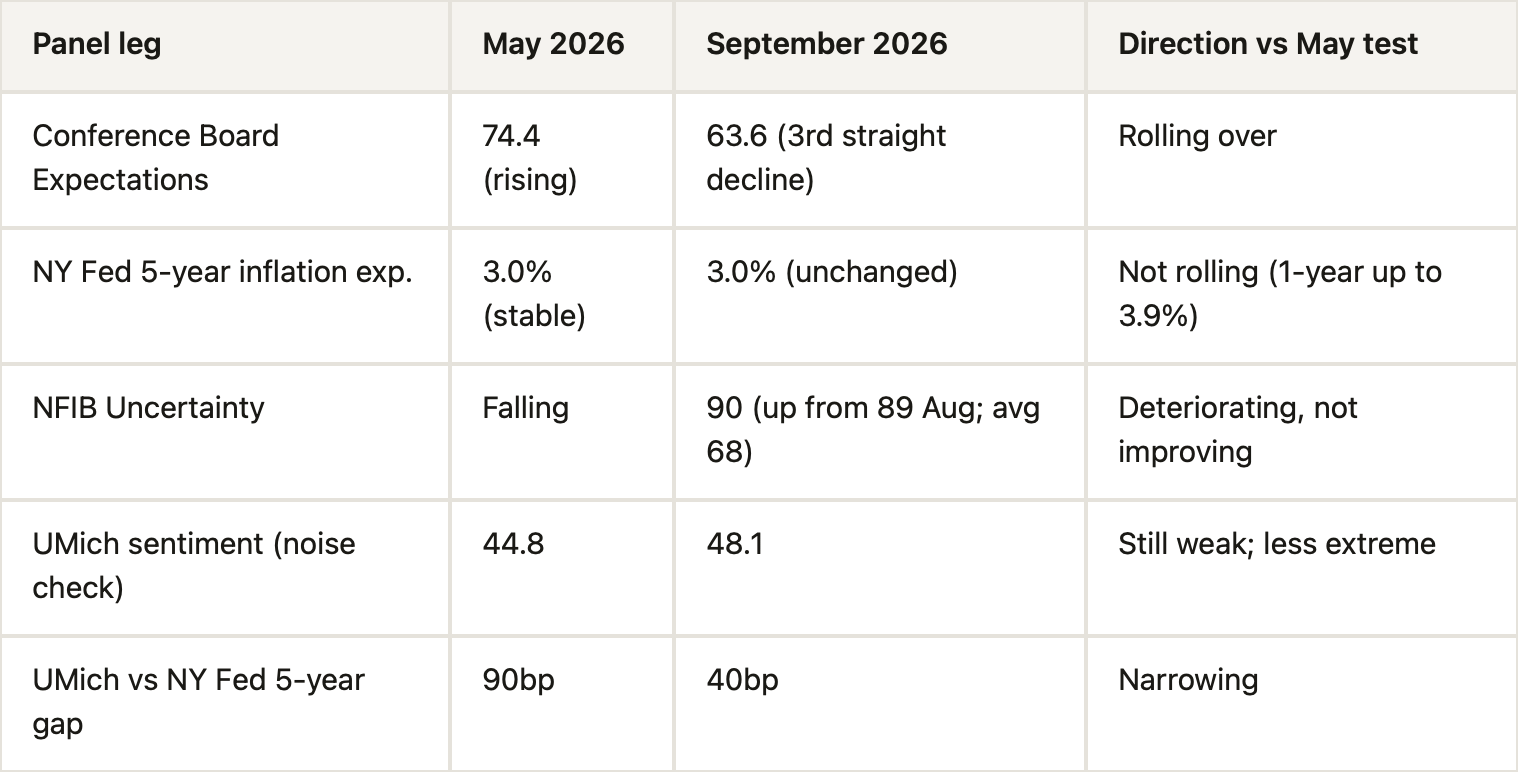
Side by side
Credit check: still holding
Bank credit-card delinquency is 2.85% in Q2 2026, seasonally adjusted — down from 2.91% in Q1 and 3.04% a year earlier (FRED DRCCLACBS / Board of Governors Charge-Off and Delinquency Rates; updated Aug. 25, 2026). That is the commercial-bank rate, not the New York Fed’s credit-file 90+ day share (a different construction). On this measure, the wallet is stressed but not breaking into a delinquency spiral.
Verdict on the May test
May’s signal set said: one rising (Expectations), one stable (SCE long end), one improving (Uncertainty falling).
October’s read after NFIB: Expectations have rolled. Uncertainty has stopped improving and sits far above average. The SCE five-year has not rolled.
That is two of three in the wrong direction, with the Fed’s long-horizon inflation anchor still holding. Under my own rule — all three rolling over together — this is not yet a regime shift. It is a clear step toward the warning I set in May. Fragile and stressed has gotten more fragile. “Not broken, yet” is still the honest line — with less room under it than in May.
If you are trading “broken consumer” (defensive staples only, dump cyclicals, duration on a Fed panic), you are still early relative to this panel. If you are ignoring the Conference Board Expectations slide and the sticky NFIB Uncertainty print because Michigan bounced off the floor, you are late to the deterioration that actually matters.
Watch the same three. The next tell is whether NY Fed five-year stays at 3.0% while Expectations and Uncertainty keep worsening — or whether the long end finally joins them.
Hope that helps.
— Matthew
Not investment advice. Macro datapoints sourced from public releases: University of Michigan Surveys of Consumers (sca.isr.umich.edu); The Conference Board (conference-board.org / PR Newswire Sept. 29, 2026); Federal Reserve Bank of New York Survey of Consumer Expectations (newyorkfed.org/microeconomics/sce, Oct. 7, 2026); NFIB Small Business Economic Trends (nfib.com, Oct. 13, 2026); Board of Governors via FRED DRCCLACBS (updated Aug. 25, 2026). Historical “lowest since August 2013” comparison on Conference Board headline attributed to PNC Economics Research (Sept. 29, 2026). Reader is responsible for their own due diligence.