

My digital feed is currently full of podcasters and fans clutching their pearls over Indiana University’s football team. They are struggling to cope with the reality that a historic cellar-dweller might actually be one of the greatest teams of all time.
They congratulate Indiana out of one side of their mouth but condemn the system that produced it out of the other side. We are told that college sports are “broken.” I am quite certain they are not.
You’ll recognize the guilty by their platitudes:
→ The transfer portal is out of control,
→ NIL collectives are “buying” players, and the lack of a salary cap has turned the locker room into a band of Hessians.
→ This is followed by the usual pieties about “greed” and “student-athletes,” as if a twenty-year-old making money is a violation of the natural law.
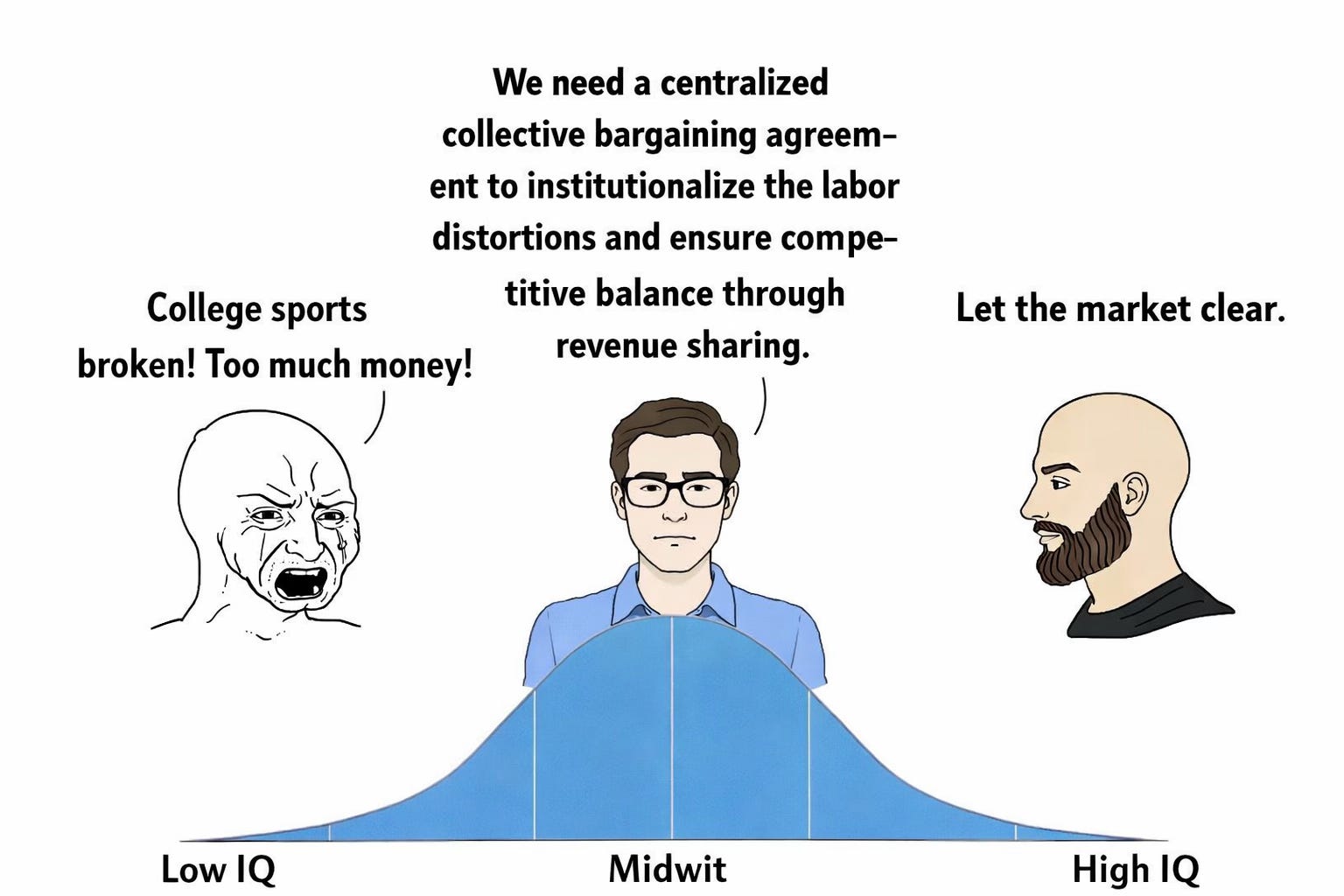
And therefore, the cry goes up that “something must be done” - usually involving a massive dose of collective bargaining to “stabilize” the sport.
Hogwash.

I am convinced of the exact opposite.
Free markets are turning college sports into the finest professional league in the Republic - provided the bureaucrats don’t find a way to ruin it.
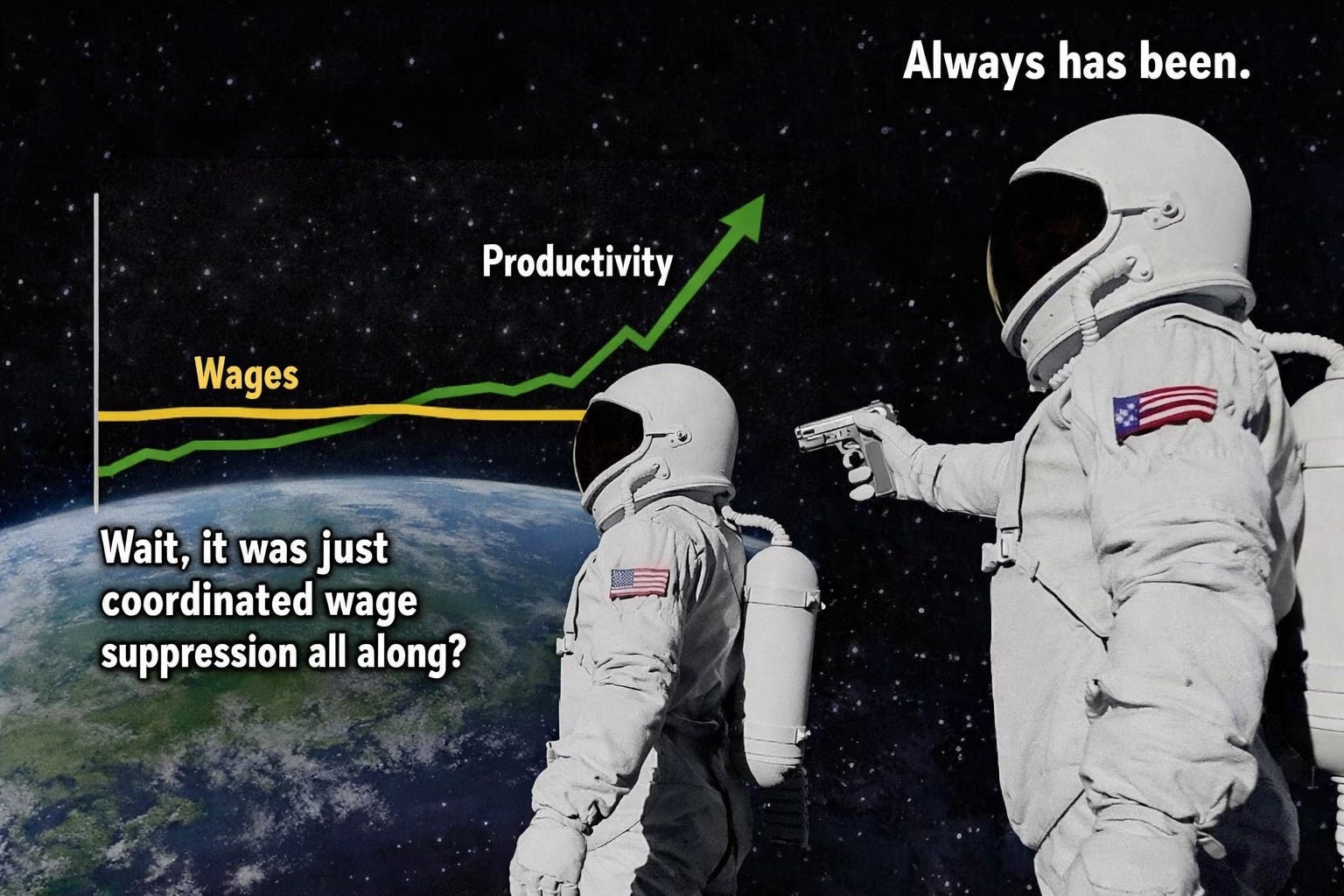
College sports are now operating closer to a genuine free market than any other “professional league” in America. What we are witnessing is the glorious, messy reality of athletic labor when you stop hitting it over the head with coordinated wage suppression.
College sports now resemble a real free labor market, offering both opportunity and a robust form of civic pride.
Professional sports, meanwhile, resemble a managed cartel.
We’ve Been Duped by the Cartels
We have been conditioned to view the NFL, NBA, and their ilk as the gold standard - the “fair” models of labor in sports. But collective bargaining does not “solve” economic problems; it merely institutionalizes a distortion and gives it a nice haircut for TV.
Salary caps, draft rights, and franchise tags are not “natural” features of sport. They are cartel mechanisms jointly enforced to benefit a small group of owners and a handful of stars at the top of the food chain.
The athlete quickly discovers that the real minimum wage is, and always has been, zero.
Why would the owners and the unions do this? These legacy leagues maximize earnings for a protected class by excluding a much larger population who could compete at the margin.
Consider the “Tom Brady Problem”: a sixth-round pick, buried on a depth chart, one injury away from a lifetime of selling insurance. (Sincere apologies to all my insurance selling friends) How many great athletes never get the chance to earn because of these artificial bottlenecks? In a capped system, the media is co-opted into protecting cartel assets, treating scarcity as if it were excellence. The NFL has 32 teams by decree, not by demand. They conspire to strangle any competing league in its crib.
You can’t do that with college, however.
College Sports: The Accidental Free Market
The amusing part is that college sports never intended to become market-based. The powers that be would have sooner sold their own grandmothers. They fell into it because the NCAA lost its ability to coordinate price controls, and the courts began punching holes in the “amateurism” bucket faster than the deans could plug them.
The result is a labor market that is chaotic, yes, but real.

A top college quarterback today possesses more labor freedom than a mid-tier NFL veteran. He can solicit competing offers, move house immediately, and re-price his value annually. Pro sports spent decades securing legal exemptions to control labor, and suddenly the “amateurs” blew the whole thing up.
The irony: the professionals are less free than the top college players.
The one remaining vestige of the old regime is “eligibility” - the NCAA’s way of reminding you they still exist. They want to keep the pro leagues happy by pushing talent up the ladder. Abolish this, and you have a full-scale competitor to the legacy cartels.


What Kind of Teams Do You Want to Support?
There is a deeper layer here: College teams are actually embedded in their communities - they are the kinds of institutions we actually want. That is a problem for the pros. And they know it.
Pro teams are franchises cosplaying as civic institutions.
Modern pro teams are privately owned monopoly assets. They are mobile at the owner’s whim and often extractive toward taxpayers. Owners “license” a civic identity to the fans, but the fans have no say in the governance.
The jersey says “New York,” but the board room says “Private Equity.”
College teams are different. They are permanently rooted. A university does not relocate to Las Vegas for a better stadium deal. Its fan base is grown, not imported.
NIL has actually deepened this bond. While the critics call it “buying players,” it is actually participatory capital. NIL collectives channel supporter money to athletes directly. It turns fans and alumni into active participants in the ecosystem rather than passive consumers of a “product.”
In college sports, money flows down and outward into the community. In the pros, it flows up and inward to the league office.
A Choice of Systems
What unsettles people about college sports isn’t “greed” - it’s price discovery. For decades, we used the mask of amateurism to hide the true value of athletic labor. Now that the mask is off, the “chaos” is simply the sound of the market finding its level.
We have a choice:
Legacy Professional Sports: ‘Stability’ and ‘parity’ achieved through artificial scarcity and cartel management.
College Sports: Opportunity and participation expanded through an open, if uneven, market. And that ‘unevenness’ might just give us an Indiana National Champion.
Do not confuse cartel stability with moral clarity. College athletics has become the most honest expression of competition we have left - open, imperfect, and wonderfully dramatic.
I take much more issue with the legacy professional leagues than I do with college sports. I love seeing players get paid. I love the Indiana story. My only real grievance is the NCAA’s eligibility circus.

So where does this leave us?
The Realistic Three Endgames
I don’t see a world where today’s NIL “situation” persists forever. I also don’t think we end up with something pure by any measure. It just feels like we are not at equilibrium that makes the power brokers happy.
The vacuum created by the NCAA’s practical demise will be filled. The only question is what the new container looks like. We are heading toward one of three conclusions:
1. The European Model (yes, European)
We stop pretending and realize college sports are like the English Premier League. No caps. Small schools become “selling clubs.” Power programs become global brands. It is unequal, but it is the most honest market in the world. And really, there is nothing more American than the threat of relegation.
2. The Institutionalized Cartel (captured, again)
This is what the traditionalists are praying for. Schools admit athletes are employees and form a massive Collective Bargaining Agreement. They trade salaries for caps and restrictions. The market gets “tamed,” the “chaos” ends, and we go back to the supply-restricted stability of a managed labor cartel. Grotesque.
3. The Great Decoupling (for the PE guys)
The “University” brand becomes a licensing play. Teams operate as private professional entities that wear the school colors and rent the stadium on Saturdays. This ends the “student-athlete” charade, but it likely severs the civic threads that make college sports special. It’s a Private Equity dream. And we know what PE does to things we love.
The opportunity here is substantial. It would, print money my man.
Final Thought: The Protectionism Trap
College sports have revealed that the “stability” we craved was built on the backs of suppressed labor. As legacy professional sports become more financially engineered, college sports are becoming more authentic. If they can make minor tweaks without restricting opportunity, they will become a bigger threat to the NFL and NBA than anyone realizes.
Writer’s Note: Thanks for reading. This is my first foray into the writing side of Substack. Appreciate any feedback!